Explore the best AI tools for business in 2025. Learn real tools for marketing, sales, support, finance, HR, and operations with practical use cases.
Artificial intelligence is no longer a future concept for businesses. In 2025, AI tools are actively shaping how companies operate, make decisions, interact with customers, and scale faster with fewer resources. From small startups to large enterprises, businesses that use AI effectively gain a clear competitive advantage.
This article is a complete, high-quality guide on AI tools for business, written in simple language with short paragraphs for easy reading. It focuses on real use cases, practical understanding, and long-term value—without unnecessary theory or hype.
What Are AI Tools for Business?
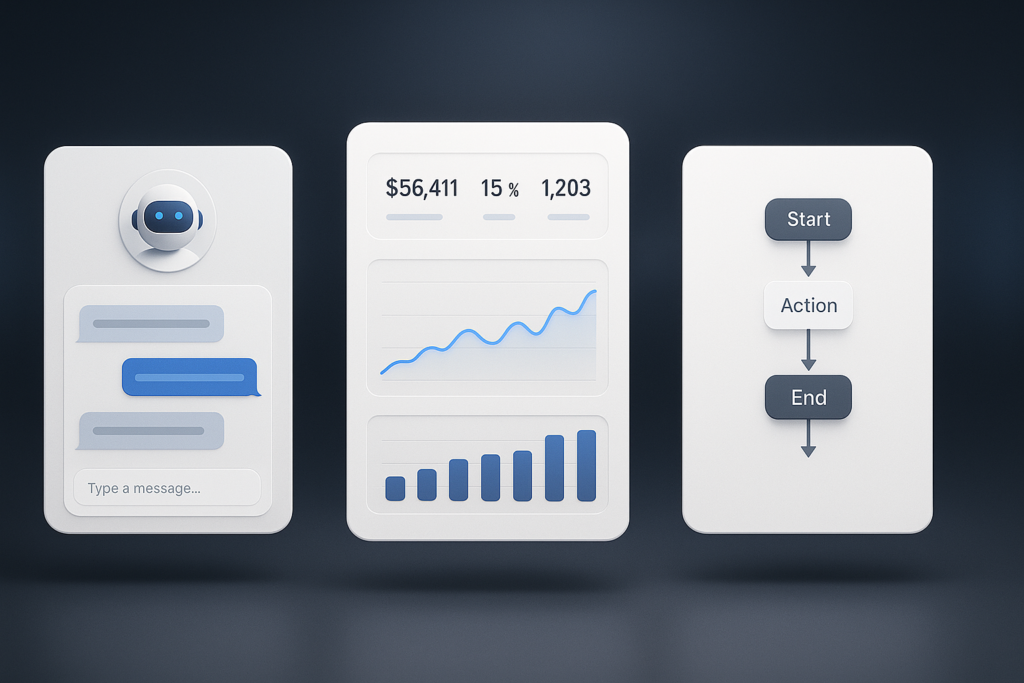
AI tools for business are software solutions that use artificial intelligence technologies such as machine learning, natural language processing, computer vision, and automation to improve business processes.
These tools can analyze data, generate content, automate repetitive tasks, predict outcomes, and support decision-making. The goal is not to replace humans, but to enhance productivity, accuracy, and efficiency.
Why Businesses Are Adopting AI Faster Than Ever
Businesses adopt AI tools because they solve real problems.
Common reasons include:
- Reducing manual work
- Saving time and operational costs
- Improving customer experience
- Making data-driven decisions
- Scaling operations without increasing staff
AI tools allow businesses to do more with fewer resources.
Categories of AI Tools for Business
AI tools for business are best understood when grouped by function. Below are the main categories with real, widely used AI tools and a clear explanation of how each tool helps businesses.
AI Tools for Marketing and Growth
Marketing-focused AI tools help businesses attract, engage, and convert customers faster.
Commonly used AI marketing tools include:
- ChatGPT / Claude – Used for content planning, ad copy, email drafts, and campaign ideas
- Jasper AI – Designed for marketing content like blogs, ads, and landing pages
- Copy.ai – Helps generate sales copy, product descriptions, and social media posts
- Canva AI – Assists with quick graphic design, banners, and social creatives
These tools reduce content creation time and allow marketing teams to test ideas quickly.
AI Tools for Sales and Lead Generation
AI sales tools focus on identifying high-quality leads and improving conversions.
Popular AI sales tools include:
- HubSpot AI – Lead scoring, CRM insights, and automated follow-ups
- Apollo AI – Prospect discovery and outreach optimization
- Zoho CRM AI (Zia) – Sales predictions and customer behavior analysis
Sales teams use these tools to focus effort where it matters most.
AI Tools for Customer Support
Customer support AI tools improve response speed and availability.
Widely used tools include:
- Zendesk AI – Ticket routing and automated responses
- Freshdesk AI – Chatbots and support workflow automation
- Intercom AI – Conversational AI for customer engagement
These tools reduce workload while improving customer satisfaction.
AI Tools for Content Creation
Content AI tools support writing, editing, and ideation.
Examples include:
- ChatGPT – Blogs, emails, scripts, and summaries
- Notion AI – Internal documentation and planning
- Grammarly AI – Writing improvement and tone suggestions
They act as productivity assistants rather than replacements.
AI Tools for Design and Creative Work
Creative AI tools allow businesses to produce visuals without large teams.
Popular tools include:
- Midjourney – Concept art and creative visuals
- DALL·E – Image generation for marketing and blogs
- Adobe Firefly – AI-powered design inside Adobe tools
These tools help maintain visual consistency and speed.
AI Tools for Data Analysis and Business Intelligence
Data-focused AI tools help businesses understand performance and trends.
Common tools include:
- Power BI with AI – Data visualization and forecasting
- Tableau AI – Pattern detection and insights
- Google Looker – Business intelligence and reporting
These tools turn raw data into actionable insights.
AI Tools for Operations and Automation
Automation AI tools streamline workflows and operations.
Examples include:
- Zapier AI – Workflow automation across apps
- Make (Integromat) – Advanced process automation
- UiPath – Robotic process automation for enterprises
Automation reduces errors and saves time.
AI Tools for Human Resources
HR-focused AI tools improve hiring and employee management.
Common tools include:
- HireVue – AI-assisted interviews
- Pymetrics – Candidate matching
- Eightfold AI – Talent intelligence and workforce planning
These tools support better hiring decisions.
AI Tools for Finance and Accounting
Finance AI tools help manage money accurately.
Widely used tools include:
- Vic.ai – Automated accounting and expense categorization
- Xero AI – Smart bookkeeping
- Planful – Financial forecasting and planning
These tools improve financial visibility and control.
AI Tools for Marketing
Marketing is one of the biggest beneficiaries of AI.
AI marketing tools help businesses:
- Generate content ideas
- Write social media posts and ads
- Create images and videos
- Analyze audience behavior
- Optimize campaigns
These tools allow marketers to test ideas faster and personalize content at scale.
AI Tools for Sales and Lead Generation
Sales teams use AI to identify high-quality leads and improve conversion rates.
AI sales tools can:
- Score leads based on behavior
- Predict purchase intent
- Automate follow-ups
- Personalize sales messages
This helps sales teams focus on leads that are more likely to convert.
AI Tools for Customer Support
Customer support is another area where AI delivers strong results.
AI-powered chatbots and assistants:
- Answer common questions instantly
- Provide 24/7 support
- Reduce response time
- Route complex issues to human agents
This improves customer satisfaction while lowering support costs.
AI Tools for Content Creation
Content is essential for branding and communication.
AI content tools help businesses:
- Write blog articles and emails
- Generate product descriptions
- Create scripts and captions
- Summarize long documents
These tools act as productivity assistants rather than content replacements.
AI Tools for Design and Creativity
Design tasks are no longer limited to professionals.
AI design tools can:
- Create logos and banners
- Generate illustrations
- Edit images and videos
- Design social media creatives
This allows small businesses to produce high-quality visuals without large design budgets.
AI Tools for Data Analysis and Insights
Data is valuable only when it is understood.
AI analytics tools help businesses:
- Analyze large datasets
- Detect patterns and trends
- Forecast demand and sales
- Generate actionable insights
These tools support smarter and faster decision-making.
AI Tools for Operations and Automation
Operational efficiency is critical for growth.
AI automation tools can:
- Automate repetitive workflows
- Manage inventory
- Schedule tasks
- Reduce human error
Automation frees teams to focus on strategic work.
AI Tools for Human Resources
HR teams use AI to manage people more effectively.
AI HR tools assist with:
- Resume screening
- Candidate matching
- Employee engagement analysis
- Performance insights
This leads to better hiring decisions and improved workplace productivity.
AI Tools for Finance and Accounting
Financial accuracy is essential for business stability.
AI finance tools help:
- Track expenses
- Detect fraud
- Forecast cash flow
- Automate invoicing
These tools reduce errors and provide clearer financial visibility.
How to Choose the Right AI Tools for Your Business
Not every AI tool is suitable for every business.
Before adopting any tool, consider:
- Your business size and goals
- The problem you want to solve
- Ease of integration
- Learning curve for your team
- Data privacy and security
Start small and expand gradually.
Common Challenges When Using AI Tools
Despite their benefits, AI tools come with challenges.
Common issues include:
- Poor data quality
- Over-automation
- Lack of employee training
- Unrealistic expectations
Successful businesses treat AI as a support system, not a shortcut.
Best Practices for Using AI Tools Effectively
To get the best results from AI tools:
- Use clear inputs and instructions
- Combine AI output with human judgment
- Monitor performance regularly
- Keep tools updated
AI works best when guided by human intent.
Ethical and Responsible Use of AI in Business
Responsible AI use builds trust.
Businesses should:
- Be transparent about AI usage
- Protect customer data
- Avoid biased decision-making
- Maintain human oversight
Ethical use ensures long-term success.
Future of AI Tools in Business
AI tools will continue to evolve.
Future developments include:
- More personalized automation
- Smarter decision-support systems
- Deeper integration across platforms
- Increased focus on explainable AI
Businesses that adapt early will stay ahead.
Real-World Examples of AI Tools in Business
To understand the real impact of AI tools for business, it helps to look at practical, everyday examples.
A small e‑commerce business can use AI tools to automatically recommend products based on customer browsing behavior. This increases average order value without additional marketing effort.
A service-based company can use AI chat assistants to handle appointment bookings, basic questions, and follow-ups, allowing the human team to focus on complex customer needs.
Manufacturing businesses use AI to predict equipment maintenance needs, reducing downtime and preventing costly breakdowns. These real-world uses show how AI directly improves efficiency.
AI Tools for Decision Support and Strategy
Beyond automation, AI tools play an important role in strategic planning.
Business leaders use AI systems to:
- Analyze market trends
- Compare historical performance
- Simulate future scenarios
- Identify risks and opportunities
Instead of relying only on intuition, businesses can support decisions with data-backed insights, improving confidence and accuracy.
Custom AI Tools vs Ready-Made Solutions
Businesses can choose between ready-made AI tools and custom-built solutions.
Ready-made tools are easier to adopt, require less technical knowledge, and work well for common use cases like content creation, analytics, and support.
Custom AI solutions are built specifically for a company’s unique processes. They require higher investment but offer deeper integration and competitive advantage for larger organizations.
The right choice depends on business size, goals, and technical capacity.
Training Teams to Work with AI Tools
AI adoption is not only about technology. It also involves people.
Employees need to understand:
- How to use AI tools correctly
- Where AI helps and where human judgment is required
- How to interpret AI-generated outputs
Businesses that invest in training see better results and fewer mistakes. AI becomes a collaborator rather than a confusing system.
Measuring the Impact of AI Tools
To ensure AI tools deliver value, businesses should measure results over time.
Important indicators include:
- Time saved on tasks
- Cost reduction
- Customer satisfaction
- Revenue growth
- Error reduction
Regular evaluation helps businesses refine how AI tools are used and ensures long-term effectiveness.
Scaling Business Operations with AI
As businesses grow, complexity increases.
AI tools support scaling by:
- Handling higher workloads without hiring proportionally
- Maintaining consistency in processes
- Supporting global operations across time zones
This allows businesses to grow faster while maintaining quality and control.
Final Conclusion
AI tools for business are no longer optional add-ons. They are practical systems that support growth, efficiency, and smarter decision-making in 2025.
When businesses use AI tools thoughtfully—combining automation with human insight—they unlock new levels of productivity and competitiveness.
The companies that succeed are not those that use the most AI tools, but those that use the right tools in the right way, with clarity, responsibility, and long-term vision.